During the time of the "Solidarity" movement in Poland, Russia played an essential role in the handling of the situation. While in the past Russia has not been shy about quelling the small rebellions, this revolutionary movement gained a substantial amount of momentum during a period in which the Soviets did not want to have an open, military conflict outside of its own borders. Thus, the game began.
As the movement continuously gained support, Russia became more frantic. It started with subtle, passive-aggressive threats: "In addressing this letter to you, we proceed not only from our concern about the situation in Paternal Poland, about the conditions and prospects for further Soviet-Polish cooperation." At the time, the basis of the rebels' movement was the economic pitfall which was Poland; clearly by threatening to shutoff Poland from the "30 to 50 percent lower than world prices" Russia was setting,--only for Poland--it meant business.
Russia's reaction to Poland's further relative inaction was slightly less subtle: "We expect that the leadership of the PUWP and the Government of the Polish People's Republc will without delay take resolute and radical steps in order to stop the malicious anti-Soviet proganda and acts which are hostile to the Soviet Union." Aside from the blatently repetitive and redundant wording, here Russia is telling Poland, specifically, what to do (Police State), and it listens.
The reaon Russia was so deeply interested in the survival of the socialist Polish state, is that (much in the same way as Ukraine now) Poland was the buffer. It was the vanguard state of the international socialist movement against the threatening West.
Sunday, April 19, 2009

Thursday, April 16, 2009
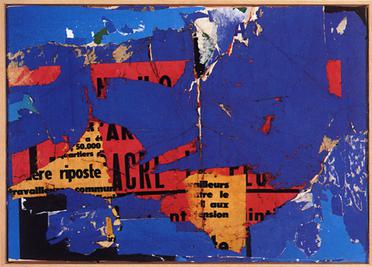
Art from class on 4/15
Following WWII and leading into the 60s, a strong feeling of distaste for all the serious, powerful seems to have taken root in many an artist's mind. This is proven by every single art piece presented by 3rd period MEH class (uncoordinated) was of this not weak, but hectic or "power"-neutral pieces: New Realism, "experimental Czech art", and 'New' Ecole de Paris.
The first piece is incredibly imbalanced, with a possible focus on the fragment of a newspaper article with only the word "riposte" visible. The fact that this article is almost entirely obscured is perhaps displaying the covering up, moving on, or pasting over of the militaristic past.
The second piece is, if anything, most evocative of some sort of disruption. However, this is not a violent explosion, but a paused, cloudy, fluttering gliding: also important is that the objects being dismantled are of an industial nature--it appears--perhaps this refers to the industrialization that came with the demanding war.
The final piece is very confusing; it is quite difficult to focus on due to the unsteadyness of the scene all while the colors used mask the piece in a certain drabness. There is no power here compared to the art during the war (remember, this piece is Russian and art is still heavily censored.
The first piece is incredibly imbalanced, with a possible focus on the fragment of a newspaper article with only the word "riposte" visible. The fact that this article is almost entirely obscured is perhaps displaying the covering up, moving on, or pasting over of the militaristic past.
The second piece is, if anything, most evocative of some sort of disruption. However, this is not a violent explosion, but a paused, cloudy, fluttering gliding: also important is that the objects being dismantled are of an industial nature--it appears--perhaps this refers to the industrialization that came with the demanding war.
The final piece is very confusing; it is quite difficult to focus on due to the unsteadyness of the scene all while the colors used mask the piece in a certain drabness. There is no power here compared to the art during the war (remember, this piece is Russian and art is still heavily censored.
Wednesday, April 15, 2009
M.A.D.
With the already overly-used title, I'll be responding to Nick's thoughts on why the U.S.S.R. and the United States didn't end up blowing each other (and everyone else) up.
I honestly believe that both sides were incredibly weary of launching, more so than is currently led on to believe. Since we're American we clearly were the ones with the higher morality and therefore must be more averse to such deadly actions than the animalistic Ivans. I think the single largest indicator of this is Colonel Petrov's story about the false positive of 6 US nuclear missile launches in 1983. At the time it was as real as it got, and obviously with nukes there is no second-guessing. But something stopped him from pressing the button; something also stopped Yeltsin from pressing the button in 1995 when there was another false positive of a US launch (obviously less of a dramatic time, but not by much). There are numerous stories, on both sides, about circumstances such as these, ranging from pesky satelites to the moon reflecting a radar transmission. While I'm usually not this type of optimistic and "humans all have shreds of humanity" person, I disagree that total annilation is/was as probable as you put on.
I honestly believe that both sides were incredibly weary of launching, more so than is currently led on to believe. Since we're American we clearly were the ones with the higher morality and therefore must be more averse to such deadly actions than the animalistic Ivans. I think the single largest indicator of this is Colonel Petrov's story about the false positive of 6 US nuclear missile launches in 1983. At the time it was as real as it got, and obviously with nukes there is no second-guessing. But something stopped him from pressing the button; something also stopped Yeltsin from pressing the button in 1995 when there was another false positive of a US launch (obviously less of a dramatic time, but not by much). There are numerous stories, on both sides, about circumstances such as these, ranging from pesky satelites to the moon reflecting a radar transmission. While I'm usually not this type of optimistic and "humans all have shreds of humanity" person, I disagree that total annilation is/was as probable as you put on.
Inscrutable.
I always had a difficult understanding where some hardcore existentialists get off on the idea of their life being so infinitesimally unimportant. The fact that the concept of suicide often enough comes into play when discussing this topic is even more interesting. First, unless every single person on this planet had the exact same point of view towards life (this existentialist mumbo-jumbo), suicide would be incredibly selfish and anything but going out of your way to improve the lives of those around you would seem to be, again, in incredibly poor taste.
Assuming life is pointless and there is no reason to continue with it, there is absolutely no reason not to attempt to better the situation for the rest of the world, for as the existentialist believes, his/her own life is rather insignificant, and thus whether he/she improves life for others or doesn't do anything ends all the same, but for the "ill-informed," who still have a shred of purpose in life, they'd only achieve greater and larger things from this extra help. There is only a plus here, no negative.
An example of the negative-nancy existentialist
A gem (with Bagel!)
Assuming life is pointless and there is no reason to continue with it, there is absolutely no reason not to attempt to better the situation for the rest of the world, for as the existentialist believes, his/her own life is rather insignificant, and thus whether he/she improves life for others or doesn't do anything ends all the same, but for the "ill-informed," who still have a shred of purpose in life, they'd only achieve greater and larger things from this extra help. There is only a plus here, no negative.
An example of the negative-nancy existentialist
A gem (with Bagel!)
Monday, April 13, 2009
Now, a touch on the Apartheid
After today's class I think it'd be pretty hard not to blog at least a tad about the Apartheid.
I cannot begin to comprehend America's reasoning for backing South Africa throughout the era; the justification that it stood as a "bulwark against communism" is a crock. In other words, to fight the inevitable oppression brought by communism, we allowed severe, actually occurring oppression to take place? The fact that this travesty spread over a whole multitude of presidents of inaction--Johnson, Carter, Nixon, Reagan--is simply disgusting. Especially disturbing are the actions of a few, specifically the vetoing of the Comprehensive Antiapartheid Act by Reagan in 1986. Does anyone understand the US's standpoint on the issue, even after the UN official condemns it in 1962? I would have preffered to end this post with some sweeping and scathing criticism, but i'm so appaulled that I simply do not understand. Were the US' hands tied in some back-door political fiasco? Gross.
I cannot begin to comprehend America's reasoning for backing South Africa throughout the era; the justification that it stood as a "bulwark against communism" is a crock. In other words, to fight the inevitable oppression brought by communism, we allowed severe, actually occurring oppression to take place? The fact that this travesty spread over a whole multitude of presidents of inaction--Johnson, Carter, Nixon, Reagan--is simply disgusting. Especially disturbing are the actions of a few, specifically the vetoing of the Comprehensive Antiapartheid Act by Reagan in 1986. Does anyone understand the US's standpoint on the issue, even after the UN official condemns it in 1962? I would have preffered to end this post with some sweeping and scathing criticism, but i'm so appaulled that I simply do not understand. Were the US' hands tied in some back-door political fiasco? Gross.
A Gander at the Past
All this talk of rebellions in today's class started me thinking about the Soviets again. While our reading of the "Long Telegram" was already a secondary source, I still find a few of the statements quite intriguing.
First, the idea that direct conflict goes against Soviet interests is fascinating. As written, the fear of instability for the Soviet Union was not of internal nature, but of foreign nations. Thus, it'd seem on the contrary, that conflict would be acceptable and profitable--in the long run--if the targets were of drastically inferior nature. Is the theory that, if the USSR attacks anyone it's as if it's striking the first domino? But, this theory wasn't--I don't believe--in place at this time (1946). It seems like there were plenty of places where conflict could easily be dismissed as not a threat to the global community, but rather to redefine Russia's borders.
Even the more modern approach to foreign policy, as outlined later in the reading, this renunciation of direct conflict continues, which is especially surprising as jargon such as "Kremlin's neurotic view...insecurity" come into play.
First, the idea that direct conflict goes against Soviet interests is fascinating. As written, the fear of instability for the Soviet Union was not of internal nature, but of foreign nations. Thus, it'd seem on the contrary, that conflict would be acceptable and profitable--in the long run--if the targets were of drastically inferior nature. Is the theory that, if the USSR attacks anyone it's as if it's striking the first domino? But, this theory wasn't--I don't believe--in place at this time (1946). It seems like there were plenty of places where conflict could easily be dismissed as not a threat to the global community, but rather to redefine Russia's borders.
Even the more modern approach to foreign policy, as outlined later in the reading, this renunciation of direct conflict continues, which is especially surprising as jargon such as "Kremlin's neurotic view...insecurity" come into play.
Wednesday, March 25, 2009
A Response to Yeat's Apocolypse
The Yeat's The Second Coming that Cas has posted fits nicely into many of the previous posts regarding the degradation, of what we maintain as humanity, in the years following The Great War and leading into WWII. Many of us still have issues understanding just how severe the circumstances were at the time, but here Yeats at least shows us that he truly thought the times were extradordinary. Lines such as: "now I know that twenty centuries of stony sleep were vexed to nightmare by a rocking cradle" show just how bad things were, or at least appeared to be. Even today, it's hard to compare WWI to WWII as the latter had a distinct purpose and there was an easily discerned moral difference, while the years-long massacre that was the Great War was fought for nearly no reason and thus created even more worry and doubt in the human race from many, many persons.
The comparison of the times by Yeats is not simply to the falling of a a government or of a nation (his being England), but of the entire world. According to Yeats, humanity as a whole has lost it's focus after this traumatic period; its good are nowhere to be found, while its bad are the ones rising up (ie. Hitler, Stalin(?)). Despite all this, "The Second Coming" generally refers to Christ's Second Coming (or Satan's falsification of The Second Coming). Perhaps Yeats meant this to be Satan's testing, and perhaps this poem isn't as apocopytic as it seems at first, for if bound to the common definition of the title, the "savior," if you will, is still coming.
The comparison of the times by Yeats is not simply to the falling of a a government or of a nation (his being England), but of the entire world. According to Yeats, humanity as a whole has lost it's focus after this traumatic period; its good are nowhere to be found, while its bad are the ones rising up (ie. Hitler, Stalin(?)). Despite all this, "The Second Coming" generally refers to Christ's Second Coming (or Satan's falsification of The Second Coming). Perhaps Yeats meant this to be Satan's testing, and perhaps this poem isn't as apocopytic as it seems at first, for if bound to the common definition of the title, the "savior," if you will, is still coming.
Subscribe to:
Posts (Atom)